Latest videos about Continuous Learning

From CDs in India to Building AI Security at PayPal
- Joseph's career journey highlights resilience, continuous learning, and adaptability, especially after a layoff forced him to return to India and pivot his tech stack. - He emphasizes the importance of understanding underlying concepts and problem-solving over merely learning tools in isolation, a common mistake in DevOps learning. - Joseph advocates for proactive learning, setting an annual budget for self-improvement, and leveraging employer-sponsored training by first demonstrating value with smaller courses. - He stresses the significance of community engagement, networking, and sharing knowledge, which not only aids personal growth but also leads to industry recognition like Docker Captain and AWS Community Builder titles. - For junior engineers, Joseph advises focusing on behavioral skills, building a portfolio with practical projects (even using AI), and actively seeking to understand company problems to deliver tangible solutions.
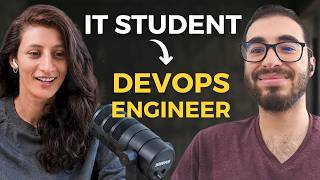
From Apprentice to DevOps Engineer: Here's the Exact Path He Took
- Amin's academic performance initially collapsed during his IT studies, dropping from top scores to failing grades in math and physics. However, he didn't give up and instead focused on improving his learning approach. - He developed a highly disciplined and organized learning strategy, emphasizing deep understanding of concepts by stopping to research any unfamiliar terms. This method proved crucial for his success in both academics and professional development. - Despite lacking technical skills for his first apprenticeship, Amin secured the role by demonstrating a positive mindset, strong willingness to learn, and confidence in his ability to acquire new skills. His attitude was more impactful than his initial technical proficiency. - Amin proactively invested in structured learning paths, such as the IT Fundamentals and DevOps bootcamps, to accelerate his career transition. This strategic investment of time and money allowed him to quickly gain in-demand skills and double his salary in a single month. - His journey highlights the importance of intrinsic motivation, setting clear goals, and continuous learning. He views an engineer who stops learning as a "dead flower," emphasizing the need for constant upskilling and curiosity to thrive in the tech industry.

AI may replace DevOps, but not for the reason you think
- **AI will not replace DevOps jobs; it will make them more valuable.** The consensus from industry experts and successful engineers is that AI is a tool that enhances productivity and scales infrastructure, rather than eliminating the need for human engineers. AI models currently have about 70% accuracy in infrastructure tasks, which is insufficient for production environments, requiring human oversight and expertise. - **DevOps engineers are becoming more powerful and in demand.** Historically, new automation technologies have enabled individual engineers to manage increasingly larger and more complex infrastructure (e.g., from 10 servers to 10,000 containers). AI is expected to continue this trend, allowing engineers to manage even more, leading to an expansion of infrastructure and projects, not a reduction in jobs. - **New specializations are emerging, all built on a DevOps foundation.** The rise of AI is creating new roles like DevOps for AI (building infrastructure for AI companies) and AI for DevOps (using AI to perform DevOps tasks more efficiently). These roles, along with MLOps and Platform Engineering, require a strong understanding of DevOps fundamentals, including Kubernetes, Docker, Terraform, CI/CD, and cloud platforms. - **Hands-on project experience and certifications are crucial for career entry and growth.** Successful engineers highlighted the importance of building complex, end-to-end projects that demonstrate practical understanding, not just theoretical knowledge. Combining a strong project portfolio (e.g., on GitHub/GitLab) with relevant certifications (e.g., CK, AWS) significantly increases visibility to recruiters and validates skills, especially for those transitioning into the field. - **Continuous learning is key to long-term career security and advancement.** The rapidly evolving tech landscape, especially with AI, necessitates ongoing skill development. Engineers who continuously learn new tools, adapt to emerging technologies, and specialize in areas like DevSecOps are highly valued, leading to faster career progression, increased salaries, and more opportunities.