Latest videos about Physics simulation

The Billion Dollar AI Advantage Is Disappearing
- **Sonnet 5.5's Capabilities**: The AI, Sonnet 5.5, demonstrated impressive abilities by reproducing complex physics simulations (AVBD) involving object collisions, friction, and joints, maintaining physical stability at high speeds. It also showcased advanced ray tracing and volumetric caustics. - **Cost-Effectiveness and Accessibility**: Sonnet 5.5 is significantly cheaper than previous high-performing AIs like Fable (5 times cheaper) and Opus 5.5 (2.5 times cheaper), while maintaining comparable quality. This suggests that intelligence in AI is more about training methodology than the sheer number of parameters. - **Implications for AI Development**: The increasing efficiency and affordability of powerful AI systems like Sonnet 5.5 mean that frontier-level AI will become accessible to individuals, potentially running on personal devices like laptops and even phones. This democratizes AI development. - **Empowerment for Individuals**: This shift will empower individuals to build complex projects that previously required large teams and significant resources. It will also make learning new skills easier and more affordable, fostering a new age of innovation and accessibility in AI. - **Sponsor Integration**: The speaker promotes Lambda.ai/papers, highlighting its utility for reproducing AI research, training models, fine-tuning, running inference, and utilizing powerful Nvidia GPUs for experiments.
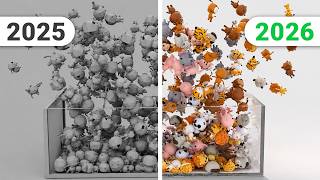
Game Physics Just Got 170 Times Faster
- A new method for simulating 'squishy' virtual objects has been developed, offering unprecedented speed and stability in computer graphics. - Traditional simulation methods struggle with deformable objects because local fixes can cause global instability (overshoot), making them slow or prone to failure. - This new technique overcomes the 'overshoot' problem by predicting how small changes in one part of an object affect the entire structure, allowing for parallel processing on GPUs. - The method is significantly faster than previous techniques (30-170 times faster than VBD) and can even handle cases where older methods fail to converge. - While there's a pre-computation step that can take time for large scenes, it can be done before a game is shipped, making the real-time simulation seamless for the end-user.