Latest videos about Open-source AI

An ex-OpenAI researcher just deleted language from the LLM...
- **Jev: A New Frontier in AI Classification**: Jev is a novel AI model developed by an ex-OpenAI researcher, designed to be a faster, cheaper, and more efficient classifier than traditional large language models (LLMs). It achieves this by removing language from the model, focusing on type-safe, gut-instinct decisions. - **Addressing LLM Flaws**: Jev tackles the verbosity and cost issues of current LLMs by providing concise, structured outputs (choice, score, null) with guaranteed schema matching, making type errors mathematically impossible. This contrasts with LLMs that often generate lengthy, expensive responses. - **System One AI for Real-time Applications**: Described as a "system one model" (referencing Daniel Kahneman's "Thinking, Fast and Slow"), Jev excels at rapid, instinctual decisions. This makes it ideal for real-time applications like content moderation, NPC behavior in video games, and other scenarios requiring immediate, low-cost AI processing. - **Calibrated Confidence and Open-Source Alternatives**: Jev provides a "calibrated confidence number" for its responses, trained with RLCD (reinforcement learning for calibrated decisions), aiming for more reliable confidence metrics than human-pleasing LLMs. Despite its proprietary nature, open-source alternatives like "OpenJev" have emerged, demonstrating similar functionality using existing models like Qwen-4B. - **Sponsor: Mux for Video Infrastructure**: The video is sponsored by Mux, a platform that simplifies adding video features to applications. Mux offers an API for hosting, streaming, and advanced AI-powered workflows like transcription, moderation, and translation, automating video processing without requiring users to manage models or pipelines.

DeepSeek’s AI Just Learned To Upgrade Itself
- **Self-Extending AI Program**: Deep Seek has released a free and open-source AI harness that allows the program to rewrite and extend itself based on user requests, creating custom functionalities on the fly. - **Customization and Adaptability**: Unlike previous harnesses, this system allows for complete rewriting of the user interface and customization of internal AI agents. Users can ask for specific modes (e.g., code review, research mode, local AI lab, video production planning) that the AI then generates. - **Robustness and Reversibility**: A key innovation is the system's ability to manage changes without falling apart. Every modification comes with automatic cleanup instructions and is reversible, thanks to a deeply integrated undo mechanism that operates separately from the original actions. - **Efficiency and Local Operation**: The system is designed to be incredibly lean and efficient, saving time and money. It can be run locally, offering privacy with no tracking or token limits, and has already garnered hundreds of community-contributed plugins. - **Revolutionary AI Interaction**: This technology signifies a shift where the operating system around AIs is no longer fixed but dynamically tailored to the user, making AI interaction more personalized and powerful.
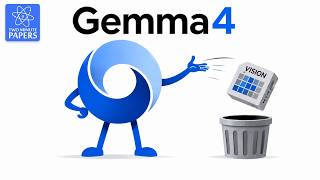
DeepMind's AI Trick Everyone Should Copy
- **Gemma 4: A Game-Changer in AI Efficiency:** DeepMind's Gemma 4 model is highlighted as a revolutionary AI, significantly smaller (99% less parameters) than large models like DeepSeek, yet capable of advanced multimodal perception (vision and audio). - **Unified Multimodal Architecture:** Unlike conventional AI that uses separate neural networks for different modalities (e.g., a dedicated vision transformer), Gemma 4 directly projects image patches and audio chunks into its main transformer. This forces the system to learn perception and reasoning simultaneously, blurring the boundaries between these functions. - **Open-Source and Accessible:** Gemma 4 is free, open-source, and can run on a laptop, making advanced AI capabilities accessible to a wider audience. It has been downloaded over 300 million times, demonstrating its widespread adoption and impact. - **Implications for the AI Community:** The shared architecture of Gemma 4 can help improve other large AI models like DeepSeek, enabling them to integrate vision and audio more efficiently. The speaker emphasizes the importance of supporting open-source AI initiatives, recognizing them as invaluable gifts to the scientific and student communities.