Latest videos about Kubernetes

If You're Ambitious But Inconsistent (In Tech), Watch This…
- **Inconsistent Learning is Ineffective for Technical Skills**: The video highlights that sporadic learning, even with significant total hours, leads to fragmented understanding and a lack of practical skills, especially for cumulative, hands-on fields like DevOps. This is because technical skills require continuous context and practice. - **The Problem of Context Loss**: Gaps in learning cause a loss of working memory and architectural understanding, forcing learners to re-learn concepts and wasting valuable time. This is particularly detrimental for DevOps, where each concept builds on previous ones. - **A System for Consistent Technical Skill Development**: The proposed solution involves a structured learning system focused on consistency, not motivation. Key components include: fixed daily 30-minute learning slots, pre-planned weekly technical outcomes (specific, testable builds), and daily documentation of work and troubleshooting. - **Importance of Hands-on Practice and Documentation**: The system emphasizes daily hands-on work to build muscle memory, encounter and solve real problems (leading to deeper learning), and understand through repetition. Documenting progress in a GitHub repository serves as reference material, proof of work, and a clear learning path. - **Compounding Effect of Consistent Practice**: By following this system, learners experience a compounding effect, where each day's learning builds on the last, leading to a comprehensive and practical understanding of the technology within a few weeks, enabling them to deploy and troubleshoot real-world applications effectively.
Kubernetes Explained in 5 Minutes
[00:00] Give me 5 minutes and Kubernetes will [00:02] finally make sense. Kubernetes has a [00:05] reputation for being the hardest thing [00:08] in tech. Well, I don't think it's hard. [00:10] I think it's usually taught backwards. [00:14] People show you all
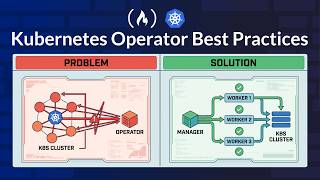
Kubernetes Operator Best Practices – Kubebuilder Deep Dive
- **Conflict Resolution in Kubernetes Operators**: The video explains a common problem in Kubernetes operators where multiple controllers or external changes can lead to conflicts when updating custom resources. This occurs because an operator might try to update an older version of an object, leading to an `object has been modified` error. - **Efficient Retry Mechanisms**: Two approaches to handle update conflicts are discussed: a "lazy" way (returning an error to trigger a full reconciler rerun) and a "pro" way (using Kubernetes' `retry.RetryOnConflict` function). The latter is preferred as it intelligently retries updates within the current reconciliation loop, avoiding unnecessary full reruns and saving compute cycles. - **Parallelism for Scalable Operators**: The speaker emphasizes the importance of making operators work in parallel, not just faster individually. By increasing the `MaxConcurrentReconciles` in the controller's setup, an operator can process multiple custom resource objects concurrently, significantly improving responsiveness and scalability for a large number of users or requests. - **Avoiding Infinite Reconciliation Loops**: A critical best practice is to prevent infinite reconciliation loops caused by status updates. The `GenerationChangedPredicate` is introduced as a solution, allowing the operator to only trigger a full reconciliation if the object's `spec` (indicated by a change in `generation`) has been modified, ignoring mere `status` updates. - **Understanding `ResourceVersion` vs. `Generation`**: The video clarifies the difference between `resourceVersion` (changes with any object modification, reflecting its state in etcd) and `generation` (only increments when the `spec` of an object is changed). This distinction is crucial for implementing efficient and intelligent reconciliation logic.

Want to 100x your value as a software engineer? 💸👇
- Software developers have a significant advantage in transitioning to DevOps due to their existing programming and problem-solving skills. - The fastest path involves learning Linux/cloud fundamentals, Infrastructure as Code (Terraform), CI/CD pipelines, and containerization (Docker/Kubernetes). - Developers' understanding of application architecture, APIs, and scalability is a strong asset that many traditional sysadmins lack. - The main challenge for developers in this transition will be mastering monitoring, logging, and incident response. - Acquiring these DevOps skills can significantly increase a software engineer's value, potentially making them 100 times more valuable than with traditional software engineering skills alone.

STOP Learning Kubernetes (Do This First)
[00:00] Everyone says, learn Kubernetes for [00:02] DevOps. Well, that's actually not a [00:05] correct advice for most people because [00:08] here is a fact, 70% of DevOps jobs do [00:12] not require deep Kubernetes knowledge. [00:14] The required core skills

CI/CD in Production with Jenkins – Complete DevOps Course
- The course is a comprehensive 17.5-hour CI/CD masterclass, consolidating 11 lectures into a single video, designed for practical, production-grade implementations using Jenkins as the automation server. - It covers foundational concepts of CI/CD, modern DevOps workflows, SDLC phases (requirement gathering, design, development, build, test, deploy, operate, maintain, feedback), and branching strategies (GitFlow and Trunk-Based). - Key technical topics include compiled vs. interpreted languages, build tools (Maven), artifact management, containerization (Docker), security practices (DevSecOps, SAST, DAST, SCA, SBOM, code quality, coverage), and advanced Jenkins features like pipelines, multibranch pipelines, and shared libraries. - The course emphasizes hands-on learning with nine projects, culminating in a complex DevSecOps mega project integrating Jenkins, Maven, Trivy, SonarQube, Amazon ECR, and Amazon EKS, focusing on real-world scenarios and avoiding "toy examples." - It stresses the importance of understanding the "why" behind actions, active practice, experimentation, and continuous learning, with all materials (YAML, Jenkinsfiles, configurations) available in a well-maintained GitHub repository.