Latest videos about Graphics Programming
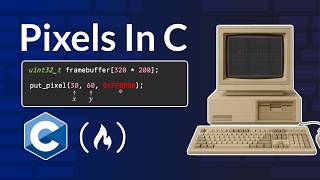
Low-Level Graphics in C – Pixel Manipulation and Frame Buffers
- This C programming course focuses on direct pixel manipulation and graphics using the SDL3 library, moving beyond traditional text-based terminal tutorials. - The course teaches how to bypass modern operating system restrictions to create and manage a low-level frame buffer, giving direct control over pixels, similar to the MS-DOS era. - It highlights the challenges of platform-specific graphics programming in C and introduces SDL3 as a cross-platform solution for handling graphics, input, and audio. - The tutorial demonstrates setting up an SDL3 window, renderer, and texture, and then manipulating a frame buffer array to display dynamic graphics, such as a "Doom fire" effect. - The instructor emphasizes the difference between CPU-based software rendering (as taught) and GPU-accelerated rendering, while still highlighting the foundational importance and power of direct pixel control in C.

Intro to Shaders – JavaScript & p5.js Course for Beginners
- This beginner's course teaches graphics programming fundamentals using p5.js and GLSL, requiring no prior experience. - It explains the core differences between CPU and GPU processing, highlighting the GPU's parallel processing for speed and shaders as the code running on the GPU. - Key concepts covered include vertex and fragment shaders, GLSL syntax (static typing, vectors, swizzling), and how data flows through the rendering pipeline. - The tutorial demonstrates practical application by building an animated fractal heart effect, introducing shaping functions (sign, step, smoothstep, absolute), inverse distance equations for glowing effects, and color manipulation with `mix` and cosine-based palettes. - It concludes by showing how to create fractals on the GPU using a `for` loop to remap UV coordinates, accumulating colors across iterations to achieve complex, layered visuals.