Latest videos about Error Handling
n8n Full Course – Architect Scalable AI Automations from Scratch
- **n8n as an Automation Infrastructure**: The course emphasizes n8n not just as an automation tool (like Zapier) but as an orchestration engine and backend for intelligent workflows, capable of automating entire business systems from lead generation to customer support. - **Building AI-Powered Workflows**: The curriculum covers creating AI agents, integrating LLMs (OpenAI, Gemini), utilizing vector databases, and designing event-driven systems for decision-making and intelligent actions. - **Practical Skills and Self-Hosting**: The course is designed for developers and no-code specialists to gain production-ready skills, including deployment and self-hosting n8n on various cloud environments like AWS or Azure. - **Key Workflow Concepts**: Detailed explanations are provided for core concepts such as workflow design principles, API orchestration (HTTP Request node), data transformation, error handling, and monitoring for reliable and scalable systems. - **Advanced AI Agent Architectures**: The course delves into advanced topics like multi-agent systems for complex tasks (e.g., content creation), using Google Sheets as a lightweight knowledge base for AI, and implementing short-term and long-term memory for persistent AI assistants.
Learn Python – Interactive Course 2016
- The course introduces Python, one of the world's top programming languages, highlighting its popularity and use in major companies like NASA, OpenAI, and Netflix. - It emphasizes Python's clean syntax, readability, and versatility, making it suitable for both beginners and large-scale production systems. - The learning approach is hands-on, focusing on building real applications and solving challenges, with an in-browser editor for immediate practice. - The first major project is building a "PayUP" expense splitting app, covering fundamental concepts like variables, data types, arithmetic operations, user input, and string formatting. - The second major project is a "Jargon Jumble" word scramble game, introducing lists, tuples, the `random` module, `if/elif/else` conditionals, `while` loops, and more advanced string methods. - The third major project is a "Sing Out" karaoke queue manager, focusing on functions, code organization (separation of concerns), `for` loops, advanced list methods (`pop`, `insert`), and robust error handling with guard clauses and `try-except` blocks.
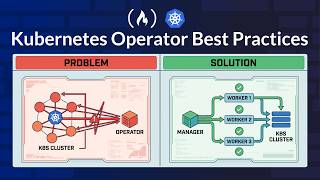
Kubernetes Operator Best Practices – Kubebuilder Deep Dive
- **Conflict Resolution in Kubernetes Operators**: The video explains a common problem in Kubernetes operators where multiple controllers or external changes can lead to conflicts when updating custom resources. This occurs because an operator might try to update an older version of an object, leading to an `object has been modified` error. - **Efficient Retry Mechanisms**: Two approaches to handle update conflicts are discussed: a "lazy" way (returning an error to trigger a full reconciler rerun) and a "pro" way (using Kubernetes' `retry.RetryOnConflict` function). The latter is preferred as it intelligently retries updates within the current reconciliation loop, avoiding unnecessary full reruns and saving compute cycles. - **Parallelism for Scalable Operators**: The speaker emphasizes the importance of making operators work in parallel, not just faster individually. By increasing the `MaxConcurrentReconciles` in the controller's setup, an operator can process multiple custom resource objects concurrently, significantly improving responsiveness and scalability for a large number of users or requests. - **Avoiding Infinite Reconciliation Loops**: A critical best practice is to prevent infinite reconciliation loops caused by status updates. The `GenerationChangedPredicate` is introduced as a solution, allowing the operator to only trigger a full reconciliation if the object's `spec` (indicated by a change in `generation`) has been modified, ignoring mere `status` updates. - **Understanding `ResourceVersion` vs. `Generation`**: The video clarifies the difference between `resourceVersion` (changes with any object modification, reflecting its state in etcd) and `generation` (only increments when the `spec` of an object is changed). This distinction is crucial for implementing efficient and intelligent reconciliation logic.