Latest videos about Computer Science History

Did you know that Dijkstra came up with his famous algorithm in about 20 minutes?
- **Origin of Dijkstra's Algorithm**: In 1956, while shopping with his girlfriend in Amsterdam, Edsger W. Dijkstra conceived one of the most important algorithms in history in just 20 minutes. - **Motivation for Development**: Dijkstra, a programmer at the Mathematical Center in Amsterdam, sought a challenging yet understandable problem to showcase the power of the pioneering Dutch computer, the New Am computer. He chose the shortest path problem. - **The Eureka Moment**: While having coffee at a cafe terrace, Dijkstra generalized the problem from finding the shortest path between two specific cities (Rotterdam to Groningen) to finding the shortest path between any two given cities. - **Unconventional Creation**: Remarkably, Dijkstra developed the entire algorithm in his head, without using pencil and paper, highlighting his extraordinary mental prowess. - **Profound Impact**: Dijkstra's algorithm became a cornerstone for various modern technologies, including GPS navigation, network routing, social media, supply chains, and robotics, profoundly impacting the future of humankind.

The 20 Minute Masterpiece: Dijkstra's Algorithm
- **Origin Story**: In 1956, while shopping with his girlfriend in Amsterdam, Dutch programmer and mathematician Edsger W. Dijkstra conceived his famous algorithm in just 20 minutes over a cup of coffee. He was trying to solve the problem of finding the shortest path between two cities for a computer demonstration. - **Algorithm's Core Concept**: Dijkstra's algorithm finds the shortest path between nodes in a weighted graph. It works by iteratively selecting the unvisited node with the smallest known distance from the source, updating the distances of its neighbors, and marking the node as visited. This process continues until all nodes are visited. - **Graph Representation**: The algorithm relies on representing real-world connections (like cities and roads) as a graph data structure, composed of 'nodes' (e.g., cities, users, warehouses) and 'edges' (connections between nodes) with associated 'weights' (e.g., distance, time, cost). - **Practical Applications**: The algorithm is fundamental to modern technology, powering GPS navigation, network routing, social media networks, supply chains, and robotics. - **Design Philosophy**: Dijkstra designed the algorithm entirely in his head, without paper and pencil, which he believed forced him to avoid unnecessary complexities and embrace simplicity. He received the Turing Award in 1972 for his contributions to computer science.
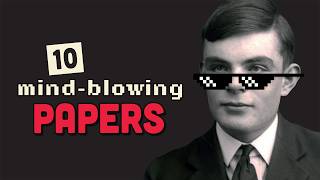
I read every major CS paper of the last 100 years...
- **Foundational Concepts:** The journey of computer science and AI began with Alan Turing's work in 1936, defining algorithms and the limits of computation (Turing Machine, Halting Problem), and Claude Shannon's 1948 paper, which quantified information in bits and introduced entropy, laying the mathematical groundwork for prediction and compression. - **Early AI and Challenges:** Frank Rosenblatt's perceptron in 1958 marked the first machine capable of learning, sparking initial AI hype. However, this enthusiasm was short-lived due to Minsky and Papert's 1969 book, which exposed the limitations of single-layer perceptrons, leading to the first "AI winter." - **Distributed Systems and Neural Network Revival:** Leslie Lamport's 1978 paper on logical clocks was crucial for distributed systems, enabling large-scale computing. The breakthrough for neural networks came in 1986 with the re-introduction of backpropagation by Rumelhart, Hinton, and Williams, allowing the training of multi-layered networks. - **Data, Compute, and Modern AI:** Google's PageRank algorithm (1998) created massive structured text data, which, combined with increased compute power (NVIDIA GPUs) and architectural innovations like AlexNet (2012) and the Transformer (2017), propelled deep learning forward. OpenAI's GPT-3 (2020) demonstrated that intelligence could emerge from massive scale, leading to the current AI boom. - **Evolution of AI:** The progression from Turing's theoretical machines to modern LLMs like ChatGPT highlights a century-long chain reaction of scientific papers, demonstrating how fundamental concepts of computation, information, learning, and scale have converged to create today's advanced AI.