Latest videos about Computer Graphics
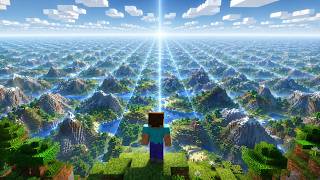
New AI Just Reinvented Minecraft Worlds
- A solo scientist has developed a groundbreaking infinite terrain generator that combines the advantages of both speed and learning, overcoming a 40-year challenge in computer graphics. - The generator utilizes a novel diffusion-based technique that decouples the cost of terrain generation from the world's size, ensuring it doesn't slow down as the generated world expands. - It introduces a "Laplacian re-extraction denoising" method for height maps, allowing the system to generate terrain with both large-scale features (mountains) and fine-scale details (ridges, river banks) simultaneously. - This innovative research was trained in just two weeks on a 4-year-old consumer GPU and is available for free, including the code and a Minecraft mod, highlighting the power of open science. - The achievement is particularly remarkable as it was developed by an independent scientist and published at SIGGRAPH, a top computer graphics conference.
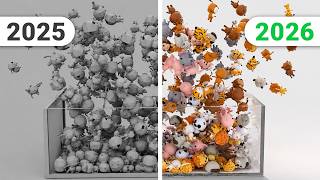
Game Physics Just Got 170 Times Faster
- A new method for simulating 'squishy' virtual objects has been developed, offering unprecedented speed and stability in computer graphics. - Traditional simulation methods struggle with deformable objects because local fixes can cause global instability (overshoot), making them slow or prone to failure. - This new technique overcomes the 'overshoot' problem by predicting how small changes in one part of an object affect the entire structure, allowing for parallel processing on GPUs. - The method is significantly faster than previous techniques (30-170 times faster than VBD) and can even handle cases where older methods fail to converge. - While there's a pre-computation step that can take time for large scenes, it can be done before a game is shipped, making the real-time simulation seamless for the end-user.